

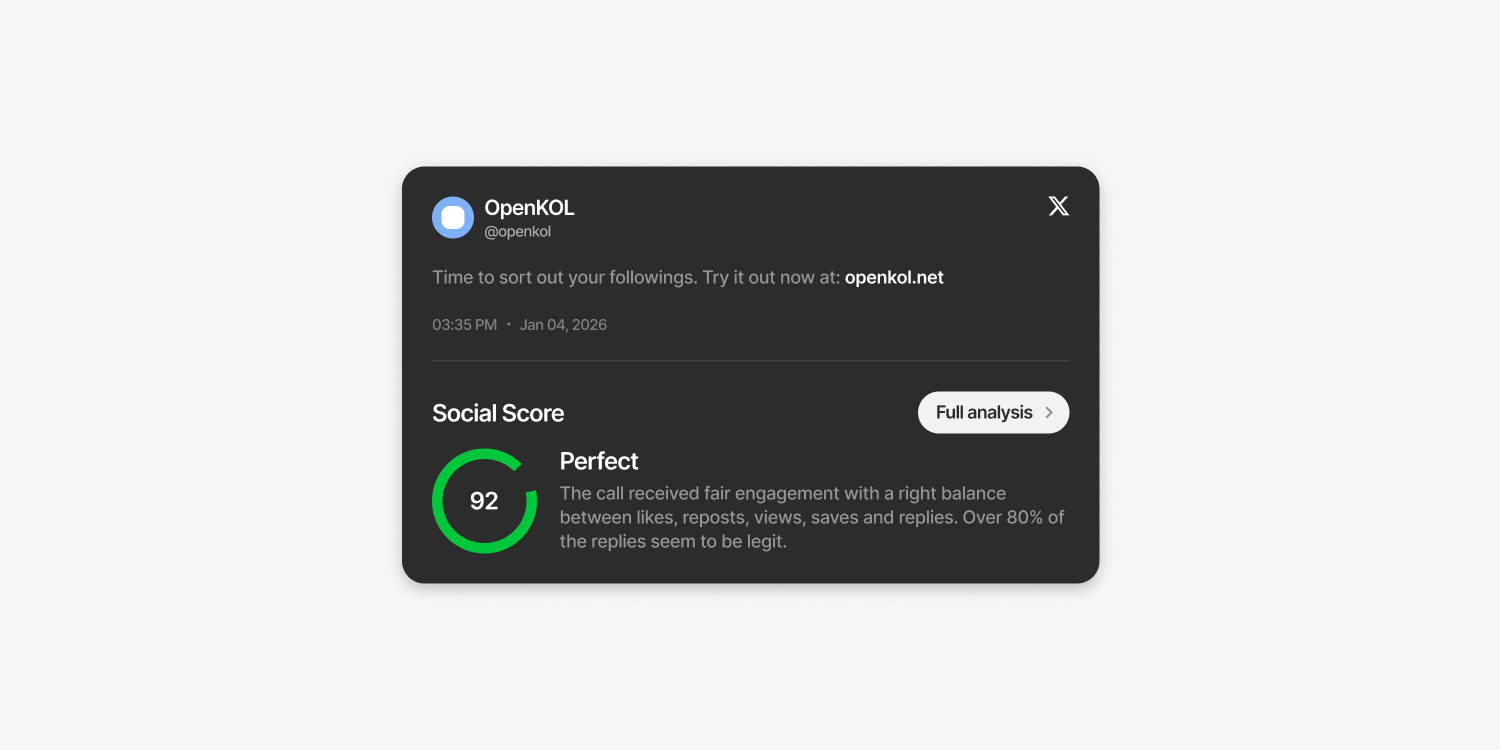
- “Big account = high score” (not necessarily true)
- “Botted / low-effort engagement” inflating metrics
Inputs
Social scoring can use:- Views, likes, reposts, replies, bookmarks
- Follower count (for normalization)
- Comment text + unique commenter identities (for quality checks)
Baseline normalization (why big accounts don’t auto-win)
Raw engagement numbers are meaningless without context. OpenKol builds a rolling baseline for each KOL from their recent activity (where available), using ratios like:- likes per view
- reposts per view
- replies per view
- bookmarks per view
- If a KOL usually gets 1.0% reposts per view, a 3.0% repost rate is meaningful.
- If a KOL already averages 3.0%, then the same number is “normal.”
Comment quality (how we reduce junk)
Replies can be the noisiest metric, so OpenKol treats them carefully. Typical protections include:- Deduplicating repeated / spammy text patterns
- Weighting by unique commenters (many different people > a few loud accounts)
- Reducing impact of very low-effort replies
Score composition (0–100)
The social score is a weighted sum of components (capped at 100):- Views: up to 20
- Likes: up to 20
- Reposts: up to 15
- Replies: up to 10
- Bookmarks: up to 15
- Comment quality: up to 20
- converting the raw metric into a ratio (often per view),
- comparing it to the KOL baseline,
- clamping to a safe range so outliers don’t break the score, then
- weighting into points.
How to interpret Social score
- High Social doesn’t guarantee the token performed — it means the call drew strong, credible attention.
- Low Social doesn’t mean the call was “bad” — it may indicate a quiet/early post that still printed (check Chart score).
- Use Social score to detect attention quality
- Use Chart score to confirm market outcome
Why this matters
Apers lose money when they confuse “loud” with “good.” Baseline normalization and comment-quality checks help:- prevent large accounts from overwhelming the score
- reduce obvious low-value engagement
- surface calls that genuinely broke through compared to a KOL’s normal reach